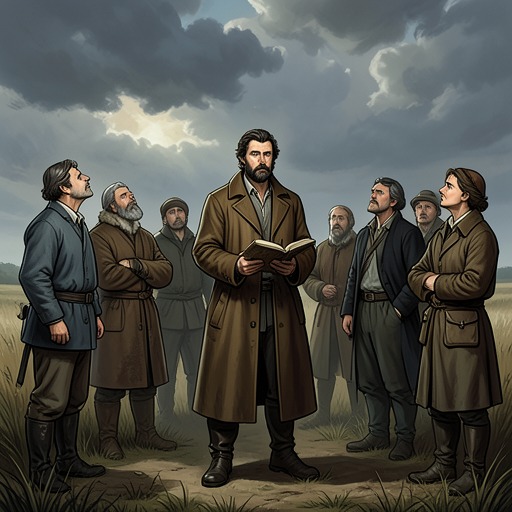
Woodruff Manifesto
Under the Banner of HeavenThe Woodruff Manifesto was the 1890 declaration through which Wilford Woodruff announced that the Church of Jesus Christ of Latter-day Saints would submit to laws against plural marriage and counsel its members to do the same. It marked a decisive change in the Church’s public policy under federal pressure, but not a clean end to plural marriage or to the religious conflict surrounding it. The declaration instead became a lasting point of dispute: Church leaders treated it as a necessary change in practice, while fundamentalists argued that it had not revoked the underlying divine commandment.
Background: Competing Claims of Authority
By 1890, the Church’s resistance to federal authority had become increasingly difficult to sustain. Under Brigham Young, the Mormon-dominated Utah Territorial Legislature had expanded local probate courts, whose judges were often bishops and whose juries were largely composed of Church members. This arrangement gave local institutions considerable power to apply religiously informed judgments, even as Utah remained a territory in which legal authority was supposed to reside in federal courts. Church leaders held that God’s laws took precedence over human laws; federal officials saw the resulting order as an exercise of theocratic control.
The conflict had sharpened over decades of opposition to plural marriage. Congress passed the Edmunds-Tucker Bill in March 1887, and federal lawyers pursued actions intended to bankrupt the Church. On May 19, 1890, the U.S. Supreme Court allowed Church holdings to be seized by the government. The legal and financial pressures were therefore not abstract: the survival of the Church’s institutional property and its ability to continue operating were at stake.
Woodruff had become the Church’s fourth prophet after John Taylor died in 1887. Taylor had died while in hiding from federal authorities, and his resistance had included sending Saints to settlements in the American West, Mexico, and Canada, where plural marriage could be practiced with less risk of arrest. The new president inherited a crisis that had outlasted his predecessor. In the book’s account, Woodruff recognized painfully that the Kingdom of God had reached a point where it could not avoid yielding to Washington’s demands.
The Revelation and Public Declaration
On the evening of September 23, 1890, Woodruff took to his bed and spent the night struggling in prayer over what should be done in the circumstances facing the Church. The following morning, he called five trusted Church leaders together. He told them that he had received a revelation directing the Church to relinquish the practice for which its members had been willing to sacrifice their lives. The decision stunned the men present: Woodruff described the change not as a matter of preference, but as the Lord’s will.
On October 6, the revelation was formalized in a short document known as the Woodruff Manifesto. It referred to congressional laws against plural marriages and to the court’s judgment that those laws were constitutional. Woodruff declared his intention to submit to those laws and to use his influence to encourage Church members to do likewise. He publicly advised Latter-day Saints to refrain from entering marriages forbidden by the law of the land. The statement thus joined a claim of revelation to an explicit commitment to legal compliance.
The form of the change mattered. Woodruff did not announce that the Church’s scripture on plural marriage had been removed. He declared that the Church would stop sanctioning the practice and publicly counsel obedience to the law. His declaration carried the authority of the Church president and prophet, a role whose title and standing were rooted in the Mormon expectation of continuing revelation. But within a faith that had also prized personal revelation, an authoritative declaration could not prevent all members from appealing to what they understood as God’s earlier commands.
Aftermath: A Public End and Private Continuation
The Manifesto shook the Mormon community, but it did not immediately end plural marriage. For the next two decades, members of the First Presidency privately advised Saints that the practice should continue discreetly, and senior Church leaders secretly performed plural marriages. The public policy and private conduct therefore diverged: a document urging submission to the law coexisted with clandestine continuation of the practice among some Church leaders.
That divergence became a fresh source of conflict when it came to light. In October 1910, the Salt Lake Tribune published the names of about two hundred Saints who had taken plural wives after the Manifesto, including six members of the Quorum of the Twelve Apostles. The resulting outrage came not only from non-Mormons but from prominent members of the Church. A movement within the institution called for enforcement of the Manifesto and the eradication of plural marriage. By the 1920s, most Saints, including Church leaders, had turned against the practice and were encouraging prosecutions of those who continued it.
The episode also exposed the limits of a public declaration as a means of settling religious practice. A pronouncement could redirect institutional policy, but it could not make every believer accept the interpretation behind it. The Manifesto brought the Church into more direct alignment with federal law, while the gap between official policy and secret practice damaged trust and deepened disagreements over who could define the faith’s obligations.
Fundamentalist Rejection and Continuing Significance
A significant number of dedicated Saints concluded that Woodruff had been mistaken and that obedience to the Manifesto contradicted the religion’s most sacred principles. They argued that it had not revoked Section 132 of the Doctrine and Covenants, Joseph Smith’s 1843 revelation on plural marriage; in their view, the Manifesto had suspended the practice under exceptional circumstances, not abolished the commandment. Section 132 remained part of Mormon scripture, supplying a textual basis for their claim.
These fundamentalists also drew authority from a revelation they attributed to John Taylor, dated September 26, 1886. It affirmed that commandments remained binding unless revoked by God or by his authority, and declared the plural-marriage law everlasting. This belief placed competing revelations and competing interpretations of prophetic authority in direct tension: Woodruff’s 1890 instruction to submit to the law stood against the fundamentalist reading of Taylor’s earlier revelation and Joseph Smith’s scripture.
The dispute extended into later generations. Dan Lafferty became convinced that the Church had gone astray around 1890, when, in his view, Wilford Woodruff had yielded the doctrine of plural marriage to a godless government. His opposition to government regulation also drew on a wider argument that licenses, taxes, and Social Security requirements intruded on individual rights. In this later setting, the Manifesto was not merely a historical change in marriage policy; it served as evidence, for some dissenters, that the institution had compromised its religious authority.
The conflict continues to frame claims about religious liberty. Fundamentalists have maintained that plural marriage is a constitutionally protected belief and that government should not interfere in their homes, while plural marriage remains illegal in all fifty states and in Canada. The Woodruff Manifesto therefore stands at the intersection of revelation, institutional authority, and civil law. It ended official Church support for plural marriage, but its ambiguous relationship to scripture, its secretive aftermath, and the enduring fundamentalist rejection ensured that it became a boundary marker as much as a resolution.